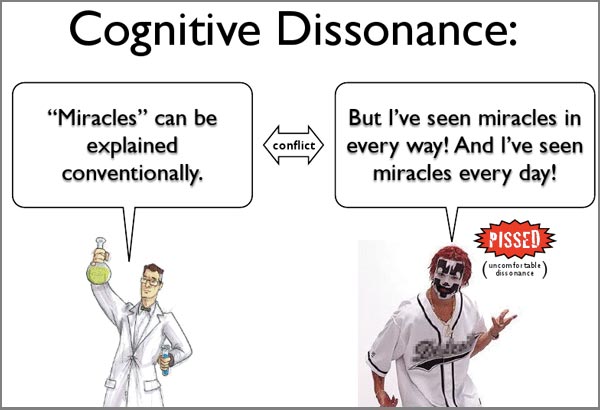
A prankster who goes by the pseudonym of "Laszlo Thoth," one of the "scientist haters" who participated in an educational prank on a horde of Juggalos in San Francisco recently, shares this Guide to Cognitive Dissonance Theory for Insane Clown Posse fans.
"It's actually a pretty good layperson's introduction to cognitive
dissonance theory," he says, "with examples that most people (including
juggalos) can relate to."
Update: The person who submitted this to me to post
on Boing Boing doesn't have much more of a sense of humor than the
Insane Clown Posse band members who confronted and threatened the
Noisebridge folks at the ICP show. "Laszlo Thoth" has removed the
linked-to content from Google Docs because he was offended at my re-use
of the term "scientist haters"
below, a reference to the ridiculous put-down the pranksters received
in person from ICP. He requested that I omit the phrase, and submitted a
rewrite of my blog post he'd rather see me publish, and I declined. For
funny people making fun of a funny song from a funny band, I'm dismayed
at the total lack of humor. Apologies for the dead link.

Perhaps the most successful use of cognitive dissonance
in the history of advertising is the AOL free-hours campaign delivered
on CD-ROM. The incentive to try AOL is provided in the form of a free
trial period. People who try the service go through a set-up process,
where they define unique e-mail addresses, screen names, and passwords,
investing time and energy to get it all to work. The greater the time
and energy invested during this trial period, the greater the
expiration. Since the compensation to engage in this activity was
minimal, the way most people alleviate the dissonance is to have
positive feelings about the service – which leads to paid subscriptions.
The interesting aspect is the Point of Minimum Justification. Until
that point is reached, a higher incentive has a positive effect on both
behaviour and attitude, in the AOL example, leading to paid
subscriptions. Beyond the point, eg. by increasing the free time or
paying more, the behaviour is still influenced, but the attidude
decreases. If AOL would offer a month of free internet, the target
audience would just use the service for a month, and then drop it. They
know there are better alternatives, but hey, as long as its free!
In the Dilbert example, by paying more to the employee, he might work
more (behaviour) but stop rationalizing (attidude) – he just does it
for the money.
Have your say!
This blog post should evolve over time and your feedback is
invaluable in achieving this by helping me fix factual errors, fill in
details, and expand the original post.